Gunilla Mørk
The CallerGunilla Mørk is a lively, reflective seventy-year-old whose confidence in the quiet security of her home is shaken when a newspaper prints her own forged obituary. The prank exploits a fear she has already begun to feel as she grows older: that death is approaching, and that the ordinary life she values may not be secure. Her response, first of shock and then of deliberate acceptance, gives the false notice a significance beyond its immediate terror.
Identity and outlook
Gunilla has recently celebrated her seventieth birthday with her children, friends, and neighbors. She is glad the gathering is over, though pleased with the food: a platter from a café and a cake table to which she contributed a marzipan ring. The occasion leaves her wondering whether she will reach eighty. She remains active, agile, and clear-headed, but the milestone has made her mortality harder to dismiss.
Her habitual outlook is one of gratitude. On a bright morning, she regards the good weather as a gift and believes people have a duty to appreciate what is good in their lives. Yet this conviction coexists with a recurring apprehension about death. At night, thoughts of it can disturb her; looking at her dry, wrinkled hand, she is briefly frightened by the visible evidence of age. She tests the hand against her cheek and recognizes that it is still warm and capable. The moment does not resolve her fear, but shows the uneasy gap between the body she knows as functional and the image of decline that has begun to intrude.
Her kitchen and garden represent the peaceful life she believes herself to have been granted. She reads about disasters and wars elsewhere, then looks out at the quiet garden and feels fortunate that nothing bad happens around her. The forged notice will violate precisely this assumption: danger arrives not from some distant catastrophe but through the familiar newspaper and into the room where she reads it.
The forged obituary
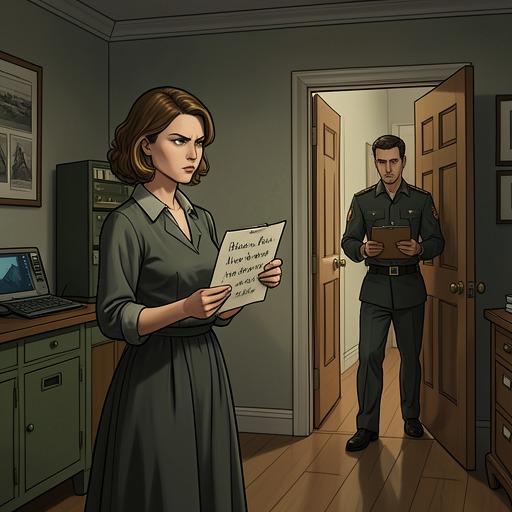
Gunilla reads obituaries carefully, partly because she may recognize someone and partly because the birth years remind her that her own time is passing. She tries to check these thoughts against the immediate facts of her morning: she is alive, the sun is coming through the window, and the coffee is strong. Then she sees her own name in the paper. The notice states that Gunilla Mørk, born 17 July 1939, has died peacefully in her sleep on 25 July, and gives details for a funeral service at the Eastern Crematorium’s small chapel on 1 August at 10:30.
The exact birth date and year make it difficult for her to dismiss the notice as a coincidence. She looks around the kitchen for reassurance, finding the familiar cups and bowls, and reads the obituary again. Her shock becomes physical: she can hardly breathe, puts a hand to her heart, lowers her head onto the table, and knocks over her coffee cup. The paper insists that she is dead while the ordinary room, and her own living body, contradict it. The scene makes the prank frightening not simply because it names her, but because it uses the authoritative, public form of an obituary to make a falsehood appear verified.
When police investigators visit, Gunilla is embarrassed to have reported what she calls a trivial newspaper notice. She says she would like to laugh it off, but cannot manage it; the laughter catches in her throat. Her apology and uncertain pacing reveal the pressure to minimize an experience that has nevertheless disturbed her. She is not merely offended by a joke. The notice has made her confront, in the language of an official farewell, the death she has already been struggling to keep at a distance.
A witness to the campaign
Gunilla’s account also gives investigators a fragment of the prankster’s approach. On the day she read the obituary, a young man came to her door looking for work. He presented himself as a Polish student who needed money and had prepared an introduction on an old pizza box because his English was poor. Gunilla had been so upset by the notice that she sent him away. Afterwards she regretted doing so, reasoning that he might have been a decent person.
The encounter is memorable in outline but not in physical detail. When Konrad Sejer later speaks with her, she cannot recall the visitor clearly; the obituary had shaken her so badly that she had not retained significant details. Her account nonetheless becomes part of the accumulated evidence. Konrad Sejer compares it with descriptions gathered from other residents, including a young man who came to buy eggs and a youth seen at a hospital. Those separate reports help him form a picture of a slender young person with longish hair, dark eyes, and a red moped. Gunilla’s evidence is therefore useful but limited: she supplies a circumstance and a disguise, while the disruption caused by the prank itself has impaired her recollection.
Her role in the investigation underscores the campaign’s double effect. The false obituary is designed to frighten and unsettle its target, but it also changes what that person can contribute afterwards. Gunilla tries to reconstruct the visit while acknowledging that she was not herself. The case turns her private distress into testimony, without making her certain of what she saw.
The notice as a lasting reminder
By the time the campaign’s wider consequences are being discussed, Gunilla distrusts Bjørn Schillinger’s claims that sabotage explains what happened. She dislikes his bitterness and aggression and suspects that he is exploiting the situation rather than responding humbly to a terrible event. Her judgment distinguishes the prankster’s known, sustained inventiveness from an explanation she finds unconvincing; she recognizes a style in the campaign without treating every accusation as established fact.
Gunilla has cut her own obituary from the newspaper and placed it in a small silver frame on the wall. Each morning, entering the kitchen, she reads the notice and thinks that her time has not yet come. What began as an instrument of intimidation becomes a ritual of her own making. The framed clipping does not erase the terror of finding her name among the dead; it lets her confront the false announcement from the other side of the shock, as a living person who has returned to the same kitchen and morning routine.
This change does not make the prank harmless. Rather, Gunilla’s response gives its central image an ironic afterlife: the obituary meant to deprive her of security becomes an object through which she affirms that she is still present. Her character joins two strands of the novel’s concern with mortality—the everyday fear that accompanies aging and the deliberate manufacture of fear by someone seeking attention. In her case, survival is registered not through a grand declaration but through the repeated act of entering the kitchen and seeing the notice on the wall.